
Metro Nashville, TN
Solid Waste Management Long-term Strategic Plan
GBB led a consulting team for the Metropolitan Government of Nashville and Davidson County (Metro) to prepare a strategic plan assessing long-term strategies to meet Metro's solid waste management and recycling needs and the energy needs of Nashville Thermal Transfer Corporation (NTTC) customers. The first step in evaluating the overall solid waste system was to develop a full-cost accounting model for Fiscal Year 2000 for the Division of Waste Management. This effort produced accurate cost data for the collection business units for benchmarking, including cost per ton by program and cost per customer. Performance data were collected for each operation in the Division of Waste Management, including collection, recycling, and disposal, through field surveys. A full range of options was developed for Metro, from minimal level services to a proactive recycling program with superior services. These three efforts informed the development of a Waste Management Model. This model was used to evaluate the costs of several scenarios for improved and expanded collection services. The results were documented in a report and presented to Metro. The Administration selected the preferred option, and the City Council approved it.
Solid Waste Disposal Services Procurement
GBB managed the full-service procurement for the transfer and disposal of over 160,000 tons of solid waste annually for the Metropolitan Government of Nashville and Davidson County. The project goal was to develop a solid waste disposal alternative for Metro, using private industry to provide high reliability and low cost for the next 30 years. To meet this goal, GBB developed procurement documents, including draft contracts that lay out Metro’s preferred terms and conditions. The procurement documents, issued as a Request for Proposals (RFP), contained specifications and requirements that Metro felt were necessary, including disposal outside of Davidson County at an existing permitted facility, provision of a business plan, provision of cost information to enable Metro to make unambiguous comparisons, and provisions for taking solid waste from all the current users of Thermal.
GBB managed the process for Metro that used the Competitive Sealed Proposals method of source selection for this procurement, as authorized by Section 4.12.040 of the Metropolitan Procurement Code. Under this method, an award, if made, is to be made to the responsible Proposer whose Proposal is most advantageous to Metro, taking into consideration price and the other factors set forth in the RFP.
The RFP requested that any firm that felt it was qualified could submit technical proposals, qualifications, and cost proposals in the form requested in the RFP. All proposals received by the specified due date and time would be evaluated.
This approach allows evaluation of differences in technical approach to determine which is in Metro's best interest. It also allows proposers to offer innovative options that Metro may not have identified, but that may be in Metro’s best interest to evaluate. The process permitted competition among the proposing vendors on criteria other than price alone. The process has a number of features, including:
Requirements that must be met for a proposer to be responsive, such as Bid Bonds and proof of insurance;
Performance specifications that allow for responses with additional detail that may depend on a proposer’s technical approach, such as the requirement to dispose of a specific quantity of municipal solid waste in one day and one year;
Draft contracts that establish the structure of the relationship that Metro wants with the contractor; and
Requests for specific information concerning the proposer, such as annual reports or SEC 10-K reports.
GBB completed the entire procurement process in less than four (4) months. Proposers had approximately two (2) months from the RFP issuance date to prepare and submit their proposals, during which time they were invited to attend a proposal conference and visit the various sites and facilities referenced in the RFP.
Option 1 - Interim Transfer and Disposal – This option would utilize an existing transfer facility to dispose of Metro solid waste that could not be disposed of at Thermal during the initial term of 19 months with a one-year renewal
Option 2.A.1 – Long-Term Transfer and Disposal – This option would utilize a privately-owned transfer station to dispose of Metro solid waste for 30 years starting at the time of closure of the Thermal facility; and
Option 2.A.2 - Long-Term Transfer and Disposal with purchase option– This option would utilize a new privately-owned transfer station to dispose of Metro solid waste for 30 years starting at the time of closure of the Thermal facility and provide Metro with an option to purchase the facility, exercisable at any time after five years from the Contract start date.
The City Council signed the contracts with the private firm selected for the project five months after project initiation, and operations began for the entire Metro waste stream in less than one year. Metro's cost dropped from $75 per ton of waste disposed to $26.50 per ton. The unit cost will escalate with a portion of the cost-of-living index during the life of the contract.
GIS Routing
GBB, in association with CIVIX L.L.C., was selected by the Metropolitan Government of Nashville and Davidson County to implement a path-routing geographic information system for the new curbside recycling collection using the FleetRoute software. This effort involved house counts and constructing a GIS database for the 130,000 single-family homes in the Urban Services District that receive refuse collection from Metro. House addresses were geocoded, and the various databases integrated and verified.
Field verification and observations were conducted before and during the route implementation for greater accuracy. The areas of Nashville were divided into two groups based on the appropriate type of collection vehicle: automated or semi-automated. Routes also guided the delivery of wheeled carts.
GBB FleetRoute Services provides Metro the following outputs: color driver and management maps; street-by-street and minute-by-minute driving directions, statistical reports for each route, and ad-hoc mapping and analysis for both the automated and semi-automated routes. Collection on the routes started in May 2002 and was fully implemented in November 2002.
The projected gains for the City are fewer routes, trucks, and crew; lower costs; and a balanced workload. Other benefits include a customer service database and the adoption of a new street network for use by other City departments.
Procurement of Demolition Services for the New Nashville District Energy System
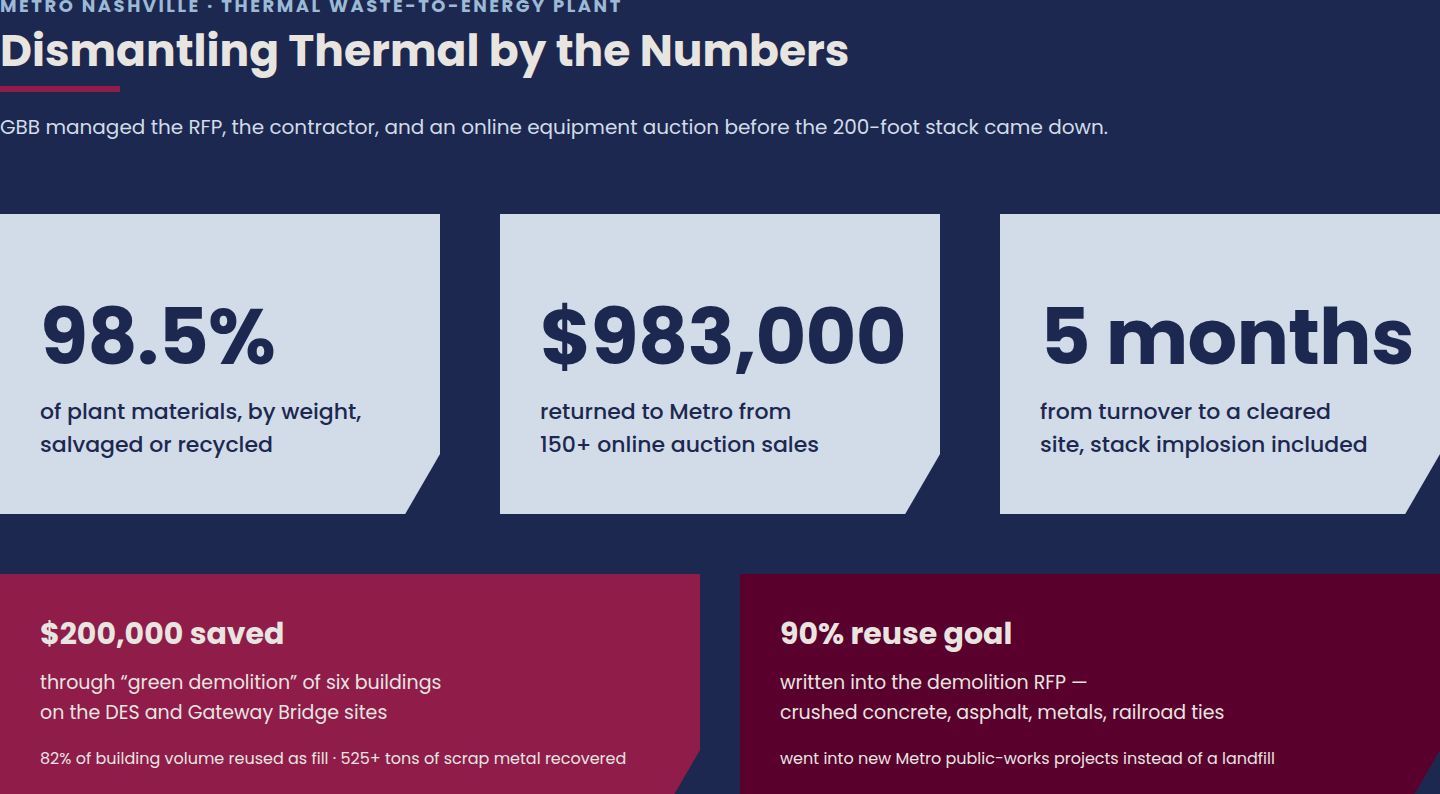
GBB assisted the Metropolitan Government of Nashville and Davidson County (Metro) with consulting for the demolition and preparation of building sites for two new projects: the new Gateway Bridge/Boulevard and the new Metro Nashville District Energy System. The development of these neighboring projects required the demolition and site-related cleanup of a total of six buildings. GBB considered different dismantling, demolition, and construction methods to yield a procurement process and contract regime that would be environmentally responsible, while also holding costs down. GBB developed an RFP with three options, including (1) traditional demolition, (2) selected demolition, and (3) optimum material segregation and salvage. Metro’s commitment to “green demolition” saved Metro an estimated $200,000 ($58,750 on the specific demolition activity plus another $140,000 by eliminating the purchase of off-site fill material for the two projects). GBB estimates that at least 82 percent of the overall volume of materials within the six buildings was re-used as fill material at the DES or contiguous Gateway Bridge site, and more than 525 tons were recovered as scrap metal.
Recycling and Demolition of Nashville Thermal Waste-to-Energy Plant
On April 19, 2004, the Nashville Thermal Transfer Corporation formally turned over the 30-year-old Thermal Waste-to-Energy plant property to Anderson Excavating Company of Omaha, Nebraska, for complete demolition. The RFP indicated a project goal of 90% reuse/recycling of the Plant.
The overall demolition process, from writing the contractor RFP to contracting, was managed by GBB. One of the unique and original aspects of the “dismantling of Thermal” was an online auction process conducted on Thermal’s fixed and used mobile equipment and parts. GBB assisted the Metro IT staff in publishing and completing over 150 auction transactions for the resale and reuse of used equipment. These auction events completed over a six-month period brought $983,000 to the Metro Nashville government, owner of the Thermal assets, reducing the overall cost to close and demolish Thermal.
The five-month project included the implosion of the large 200-foot concrete stack. Considering all site-related work, GBB has calculated that 98.5%, by weight, of all the materials within the old waste-to-energy plant were either salvaged for reuse or processed for recycling including materials such as crushed concrete aggregate, crushed asphalt, metals, railroad ties, and used equipment. New Metro public works construction projects were the strategic recipients of many of these recycled materials, saving the Metro costs of buying virgin materials.
District Energy System Study and Implementation
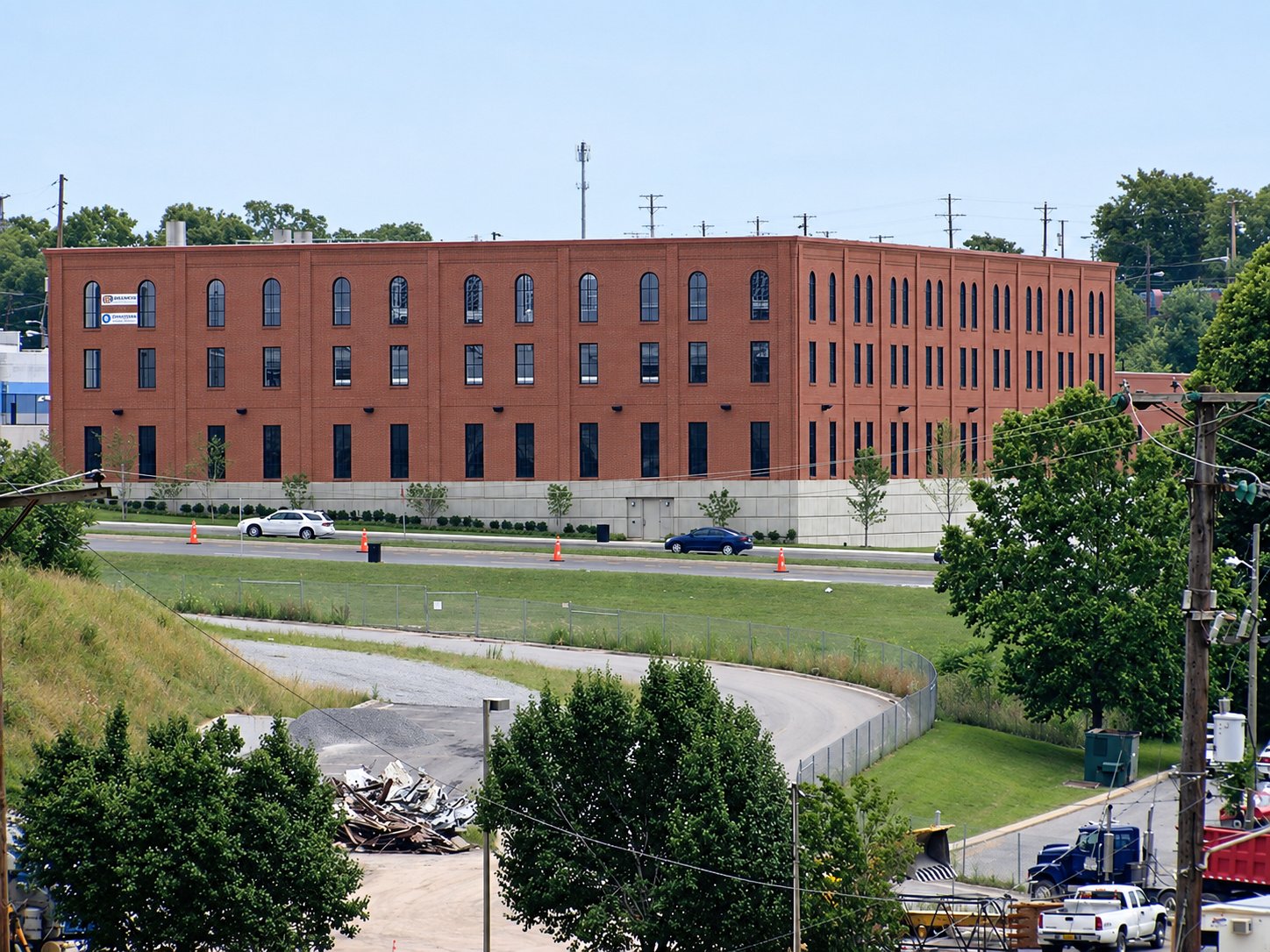
As a result of GBB's comprehensive solid waste management analysis for the Metropolitan Government of Nashville and Davidson County (Metro), Metro selected the alternative of replacing its aging and inefficient waste-to-energy Nashville Thermal Transfer Corporation facility ("Thermal") with a new District Energy System in downtown Nashville. GBB was retained by Metro to manage the procurement process for selecting a contractor to design, build, and operate the new Energy system. GBB prepared the Request for Proposals, assisted Metro in evaluating the proposers, negotiated a successful contract with the selected proposer, and managed the implementation of the project. GBB was also the lead consultant in the feasibility study leading to the successful financing of $66.7 million in bonds to finance, of part, the construction of a new 43,450 square foot, two-story building to house the highly efficient steam and chilled water generating facility which began operating in December 2003.
The Metro Nashville District Energy System provides heating and cooling to nearly 40 buildings in downtown Nashville. The facility operates nine chillers and four boilers and can provide 23,400 tons of chilled water for cooling and 260,000 pounds of steam for heating. The Nashville Thermal Transfer Corporation formally turned over the 30-year-old Thermal Waste-to-Energy plant for complete demolition. The overall demolition process was managed by GBB. GBB also served as Metro's Project Administrator, overseeing all phases of the project, including management of the District Energy System, financial and system planning, customer service, adding new customers, and the transition and closing of Thermal.
District Energy System Public Information Program
As Project Administrator for the redevelopment of the district energy system (DES), GBB designed and oversaw the implementation of a public information campaign to communicate information about the development of the new DES and to convey a positive public image for the new facility. GBB’s efforts included creating a logo for the facility, creating DES web content that could be incorporated into Metro’s official website, publishing a general informational brochure about the new DES, and publishing periodic newsletters distributed in both hard copy and electronic format to interested parties. Throughout this process, GBB worked closely with graphic design and public relations sub-consultants in identifying and creating pieces necessary to establish a positive image for the new DES.
District Energy System Project Administration Services
GBB also served as Metro's Project Administrator to oversee all phases of the project. GBB led a team of advisors in providing the Metro Nashville DES Project Administration Services from the time transition activities initiated toward the end of construction of the Energy Generation Facility (EGF) and new Energy Distribution System (EDS) interconnection.
The GBB Team provided acceptance testing monitoring and a full range of project administration services during the commercial operations period. GBB was responsible for overseeing the use of the remaining amounts of the 2002A Bonds, the use of the 2005B Bonds; and establishing and tracking budgets. The GBB team also monitored and oversaw services provided to DES customers by CEPS. Additionally, the GBB team was instrumental in helping secure several new customers to the DES including the Sun Trust Bank Building, Metro New Library, Metro Hume Fogg School, Viridian Tower, the new Schermerhorn Concert Hall, and the new Metro A.A. Birch Courthouse. As required, GBB team services included contract negotiations, design, and construction monitoring of the interconnections as well.
During GBB’s tenure as Project Administrator, the Metro Nashville DES received several awards demonstrating its excellence, including recognition from the International District Energy Association and ACEC of Tennessee.
“…thank you and your colleagues at GBB for your dedication, hard work and professionalism as we have worked together over the past seven years. […] The dedication and willingness of your entire team to consistently exceed expectations is deeply appreciated.”
— David Manning, Former Director of Finance, Metropolitan Government of Nashville and Davidson County, TN
“I would like to take this opportunity to let you [Harvey Gershman - Metro Nashville DES Project Administrator and GBB President] and know how much I appreciated how you and your organization handled the transition from the old Thermal plant to the new District Energy System. There were several aspects of the process that were done particularly well. First and foremost the communication from you to us, the customer, was consistently timely and thorough. I absolutely appreciated the customer meetings that you hosted that gave us a voice in the decisions concerning service interruption scheduling. Once a decision had been made to schedule the interruption of service, you always stayed inside your time estimates. That was most impressive and pleasantly surprising. I would also like to commend Mr. Chuck Tucker. He and I spoke often throughout the process. He came to the Ryman and met with me and my maintenance staff and showed us the step-by-step process of shutting ourselves down prior to the service interruption and the reverse process for the restoration of service for both the steam and the chill water. It was very reassuring to know that Chuck was out there on the job. In the aftermath of the transition, we have had nothing but flawless service. You can count Ryman Auditorium as a "satisfied customer”
— Bob O'Neal, Operations Manager, Ryman Auditorium, Nashville, Tennessee